


Three years ago, a Global Capability Center (GCC) meant almost nothing to a CFO outside Bangalore. Today, it is the line item that decides whether a Fortune 500 company hits its product roadmap or slips a year behind a competitor that offshored smarter with a GCC in India.
Most global leadership teams run into one problem: they know India is where the talent is, and the cost math works. What they don't know is:
- Which of five very different operating models to use?
- Which of seven cities actually fits their function?
- What is a realistic budget when you include the hidden costs?
- What are compliance's most common errors that can turn a 6-month plan into 18-month chaos?
And with a lack of information, they show up as a GCC that opens with the wrong city, the wrong legal structure, or the wrong hiring sequence — and takes two years and a leadership change to fix.
You will not need anything other than this guide on your journey from "what is GCC" to a signed lease, a registered business, and an employment strategy. It covers the definition of GCC along with a comprehensive roadmap and where the whole ecosystem is headed.
What is GCC?
A Global Capability Center (GCC) is a company-owned offshore center that a multinational company sets up to deliver core, high-value business functions like engineering, R&D, AI, data, finance, and cybersecurity directly under the parent company's management, brand, and IP ownership.
The defining features of a GCC:
- Ownership: The parent company owns the legal entity outright.
- Employment: Staff are direct employees of the company, not contractors of a vendor.
- IP: Everything built — code, patents, designs, research — belongs to the parent company with no ambiguity.
- Scope: Engineering, R&D, finance, cybersecurity, data science, and customer experience — the same work done at headquarters.
- Culture and governance: The center runs on the parent company's processes, tools, and reporting lines, not a third party's SLA.
Global Capability Center Vs. Different Setups
The single question that sets a GCC apart from any other offshore model: is it solely owned by the company setting it up? If the answer is "we do, fully," it's a GCC. If the answer is "a vendor does, and we buy outcomes," it's outsourcing.
| Model | Who Owns It | Who Employs | Typical Work | Control | Best Fit |
|---|---|---|---|---|---|
| BPO | Third-party vendor | Vendor | Transactional, high-volume (support, claims, back office) | Low — via SLAs | Non-core, highly standardized processes |
| KPO | Third-party vendor | Vendor | Research, analytics, legal/financial analysis | Low–medium | Specialized analysis without building capability |
| Shared Services (SSC) | Parent (sometimes co-managed) | Parent or co-managed | Finance, HR, procurement | Medium | Cost efficiency on repeatable internal processes |
| IT Center | Parent company | Parent company | App maintenance, infrastructure, helpdesk | Medium–high | Keeping core systems running reliably |
| Engineering / R&D | Parent company | Parent company | Product engineering, embedded, hardware-software | High | Dedicated product development capacity |
| GCC | Parent (fully owned) | Parent company | All of the above, plus AI, data science, cybersecurity, strategy | Full | Long-term, multi-function India capability |
Why Has India Become the Global GCC Capital?
India leads global GCC setup because it combines four things no other country matches simultaneously:
- Talent Depth: India produces roughly 2.5 million STEM graduates annually — hiring 200 engineers in Bangalore isn't drawing from a narrow stream.
- Mature Engineering & Startup Ecosystem: Two decades of IT services built a bench of engineering managers and architects who have run global-scale systems, layered with a thriving product-startup scene.
- Cost Advantage: A 30–50% operating cost advantage over the US and Europe — and an 82% advantage on comparable roles once infrastructure, salaries, and overheads combine. Critically, it's cheaper senior labor too.
- Government & Policy Tailwind: States like Maharashtra, Telangana, Karnataka, Tamil Nadu, and Gujarat run dedicated GCC/IT policies with incentives on stamp duty, power tariffs, and payroll subsidies, backed by DPIIT reforms and the SPICe+ portal.
The numbers explain the urgency. As of FY2026, India hosts 2,117 GCCs, employing 2.36 million professionals and generating $98.4 billion in annual revenue — a 32% jump in GCC count since FY2021, per the Zinnov–NASSCOM GCC Value Orbit Report.
| Metric | FY2026 Figure | Source |
|---|---|---|
| Total GCCs in India | 2,117 (across 3,728 units) | Zinnov–NASSCOM, FY2026 |
| Total GCC workforce | 2.36 million professionals | Zinnov–NASSCOM, FY2026 |
| Combined GCC revenue | $98.4 billion | Zinnov–NASSCOM, FY2026 |
| Forbes Global 2000 with an India GCC | 506+ | Zinnov–NASSCOM, FY2026 |
| Growth in GCC count since FY2021 | +32% | Zinnov–NASSCOM, FY2026 |
| Projected revenue by 2030 | $105 billion+ | NASSCOM projections |
| Projected workforce by 2030 | 2.8 million | NASSCOM projections |
| Share of India's Grade-A office leasing | ~38–40% | JLL / industry research |
Indian Cities Leading the GCC Growth
Ten years ago the answer was cost. Today, talent density for AI, cloud, and data roles keeps country heads in India — cost is now the second reason, not the first.
- Bengaluru — the bedrock, with 1,080+ GCCs and nearly a third of India's GCC talent, high in AI/ML and senior engineering.
- Hyderabad — the fastest-growing Tier-1 hub for life sciences, data engineering, and BFSI-adjacent work.
- Pune — nearly doubled its GCC count since 2019 on automotive and SaaS engineering.
- Chennai — strong, underrated position in BFSI and semiconductor engineering.
- GIFT City (Gujarat) — India's International Financial Services Center, a specific draw for BFSI and fintech GCCs.
- Coimbatore, Kochi, Jaipur, Indore — emerging for 25–35% further cost savings with structurally lower attrition.

The City-Fit Matrix
Don't pick a city on reputation alone. Score each candidate 1–5 against the factors that actually predict success, weighted to your priorities:
| Factor | Weight | Why It Matters |
|---|---|---|
| Talent depth for your function | 30% | A city can look great on paper yet be shallow for a niche skill (embedded vs. generic full-stack). |
| Cost structure (rent + comp + rehiring) | 25% | Headline salary savings can be erased by attrition-driven replacement costs. |
| Attrition and workforce stability | 20% | Directly impacts delivery continuity and knowledge retention. |
| Infrastructure and connectivity | 10% | Grade-A office availability, airport access, power reliability. |
| Government incentives & ease of business | 10% | State-level GCC policies can materially offset setup cost. |
| Strategic / regulatory proximity | 5% | Mainly for BFSI, fintech, and government-facing GCCs. |
Note: Multiply each factor's score (1–5) by its weight, sum across cities, and you have a defensible, board-ready comparison instead of "everyone else is in Bangalore, so we will be too."
What Are the Benefits of Setting Up a GCC in India?
A GCC in India gives global enterprises direct control over AI and engineering talent, with benefits that compound over 3–5 years in ways outsourcing cannot replicate.
- Innovation Capacity: Teams dedicated to creating patents, tools, and systems — not just closing tickets.
- 24x7 Development: A 10–13 hour timezone overlap enables genuine follow-the-sun cycles.
- Product Engineering Ownership: GCCs now own complete product lines end-to-end, not just modules.
- R&D Depth: Patent filing and fundamental work are moving to India in semiconductor, pharma, and automotive.
- Cybersecurity Capability: Dedicated SOCs and threat research teams, closer to the engineering they protect.
- Cloud & DevOps Maturity: Certified cloud engineers at a fraction of US/EU rates.
- Data Engineering Scale: Some of the largest, most specialized data benches supporting global ML pipelines.
- Scalability: Add or reduce headcount by dozens each quarter, not constrained by tight home-market pools.
- Employer Branding: A well-run GCC becomes a sought-after local employer, lifting offer acceptance and referrals.
- Long-term Enterprise Value: Institutional knowledge stays in-house instead of leaving with a vendor contract.
- AI & Data Talent Access: India hosts the world's largest enterprise AI talent pool — 126,000+ AI professionals already work inside GCCs.
What Are the Types of GCC Models?
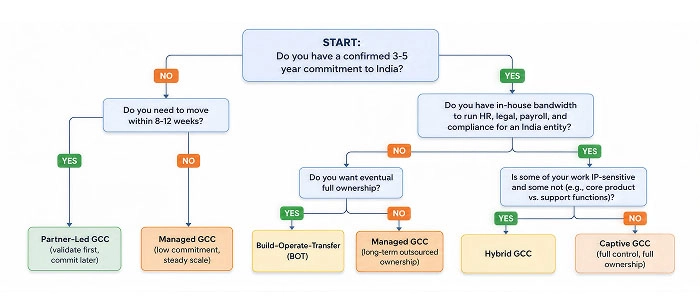
There are five common GCC operating models on a single spectrum — trading speed and risk against long-term control and cost.
1. Captive GCC
A fully owned and operated offshore center established by the parent company, which directly controls its people, technology, regulations, and processes.
Pros
- Complete ownership and strategic control
- Strong data security and IP protection
- Consistent company culture and governance
- Greater flexibility in scaling operations
- Ideal for long-term innovation and R&D
Cons
- High initial investment
- Longer setup timeline
- Greater responsibility for hiring, compliance, and operations
2. Build-Operate-Transfer (BOT) GCC
A local partner sets up and manages the GCC on behalf of the company. Once stable and operational, ownership transfers to the parent organization.
Pros
- Faster market entry
- Lower operational risk during setup
- Access to local expertise and talent networks
- Smooth transition to full ownership
- Reduced burden during initial stages
Cons
- Less operational control during the build phase
- Dependency on the implementation partner
- Transition requires careful planning
%20Model%20Actually%20Runs.webp)
3. Managed GCC
The company enters a service agreement with a third-party provider, who assumes responsibility for recruitment, infrastructure, payroll, legal/regulatory, IT, and operational roadmapping.
Pros
- Minimal upfront investment
- Quick setup and faster scalability
- Reduced administrative workload
- Simplified compliance and workforce management
- Access to experienced operational teams
Cons
- Limited operational control
- Dependence on the service provider
- Customisation may be restricted
4. Hybrid GCC
Internal ownership combined with outsourcing to partners. The company controls key functions (engineering, product, R&D) while less-core activities are outsourced.
Pros
- Balance between control and flexibility
- Optimized operational costs
- Faster scaling with partner support
- Enables focus on core business functions
- Easier access to specialized expertise
Cons
- Requires strong governance and coordination
- Potential communication gaps between teams
- Vendor management becomes critical
5. Partner-Led GCC (GCC-as-a-Service)
An outsourced model where an experienced GCC consulting partner establishes, manages, and continuously optimizes the center while the enterprise focuses on business outcomes.
Pros
- Fastest setup model
- Lowest operational complexity
- Access to proven GCC expertise
- Lower investment and business risk
- Scalable and flexible engagement model
Cons
- Reduced direct control over daily operations
- Long-term reliance on the service provider
- Requires well-defined governance and SLAs
Quick Comparison of GCC Models
| GCC Model | Ownership | Setup Speed | Initial Investment | Control | Best For |
|---|---|---|---|---|---|
| Captive GCC | Full ownership | Moderate | High | Very High | Large enterprises, long-term operations |
| Build-Operate-Transfer (BOT) | Partner initially, then transferred | Fast | Medium | High after transfer | First-time India entrants |
| Managed GCC | Company-owned, partner-managed | Fast | Low to Medium | Medium | Mid-sized companies, rapid expansion |
| Hybrid GCC | Shared ownership and operations | Moderate | Medium | High | Scaling organizations needing flexibility |
| Partner-Led (GCC-as-a-Service) | Partner-managed | Very Fast | Low | Medium | Businesses seeking an end-to-end setup |
Which GCC Model Should You Choose?
What is the Step-by-Step GCC Setup Process?
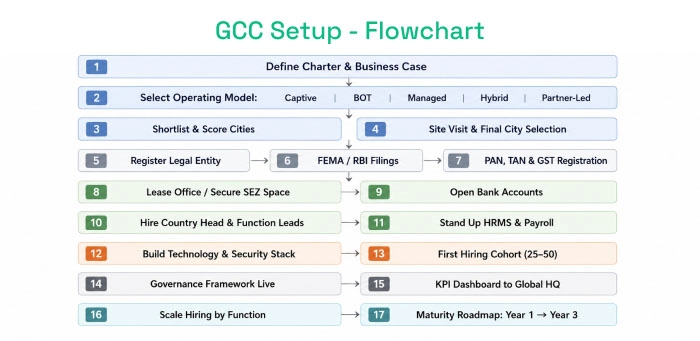
Setting up a GCC in India generally takes 6–18 months, depending on the business model, hiring, regulatory approvals, and complexity. Most delays come from underestimating the hiring and compliance phases — not legal incorporation itself.
Step 1: Strategy & Market Assessment (4–8 Weeks)
- Define the GCC's vision, objectives, and operating model
- Decide between Captive, BOT, Managed, Hybrid, or Partner-led
- Estimate investment and operational budgets
- Identify preferred cities based on talent and business goals
- Create an implementation roadmap
Primary owner: HQ leadership with a GCC consulting partner.
Step 2: Legal Entity & Business Setup (6–14 Weeks)
- Register the business entity (Private Limited, LLP, or Branch Office)
- Complete FEMA and RBI compliance, where applicable
- Obtain PAN, TAN, and GST registration
- Open corporate bank accounts
- Lease office space or secure an SEZ location
- Complete statutory registrations and local compliance
Primary owner: Legal counsel and local compliance advisors.
Step 3: Talent Acquisition & Infrastructure (8–16 Weeks)
- Recruit the GCC Head and leadership team
- Hire the first wave of employees
- Set up HR, payroll, and onboarding procedures
- Establish office infrastructure and workstations
- Finalize recruitment partnerships
Primary owner: Local HR team and hiring partners.
Step 4: Technology & Security Implementation (6–10 Weeks)
- Configure cloud infrastructure
- Implement identity and access management (IAM)
- Deploy collaboration and productivity tools
- Install endpoint security and monitoring
- Prepare for certifications like ISO 27001 or SOC 2, if required
Primary owner: IT and cybersecurity teams.
Step 5: Launch, Governance & Scaling (Ongoing)
- Establish KPIs and reporting frameworks
- Hold governance meetings with global stakeholders
- Scale hiring based on business demand
- Optimize operations and processes
- Expand into new functions and innovation initiatives
Primary owner: Country Head and Global Executive Sponsor.
Common Challenges & Their Solutions
The recurring issues — hiring at the right seniority mix, 16–25% attrition, bridging time zones and culture, evolving compliance, and scaling governance — are known problems with a known playbook.
- 1. Hiring Speed vs. Quality → Use structured technical assessments, involve global leaders in interviews, and prioritise quality over speed.
- 2. High Employee Attrition → Offer competitive compensation, clear career growth, and a strong employee value proposition (EVP).
- 3. Culture & Communication Gaps → Encourage regular collaboration, transparent documentation, and frequent HQ–GCC interaction.
- 4. Compliance Complexity → Partner with experienced legal advisors and maintain a compliance calendar.
- 5. Scaling Beyond the Founding Team → Standardise processes early and implement a scalable governance framework.
- 6. Leadership Bandwidth → Appoint a dedicated GCC leader to own operations, decisions, and expansion.
- 7. Security & Data Protection → Implement global security standards, strong access controls, and continuous monitoring from the start.
- 8. Remote & Hybrid Work → Define clear hybrid policies, use collaboration tools, and review productivity and engagement regularly.
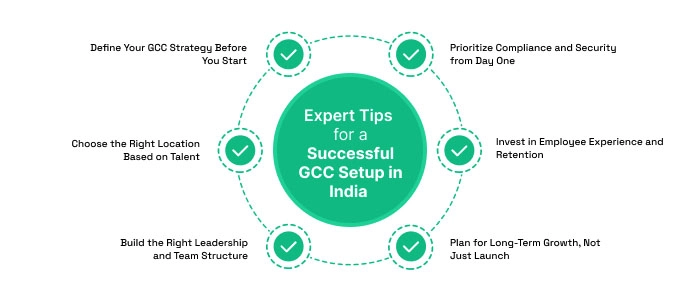
Expert Tips for a Successful GCC Setup
- 1. Define your GCC strategy before you start — vision, goals, operating model, and scope before location and hiring.
- 2. Choose the right location based on talent — not popularity; weigh talent pool, cost, infrastructure, churn, and scale.
- 3. Build the right leadership early — bring in an experienced GCC or Country Head from day one.
- 4. Prioritize compliance and security from day one — legal, tax, labour, and strong cyber/identity/data controls.
- 5. Invest in employee experience and retention — compensation, career progression, development, and culture.
- 6. Plan for long-term growth, not just launch — future-proof processes, governance, and technology tracked against KPIs.
How GCC Consulting Partners Help
Partnering with GCC consulting services on location selection, entity formation, recruiting, tech enablement, and operations can compress an 18-month deployment down to 6–9 months, with significantly lower risk than building everything internally.
- Location and model strategy — data-backed city and model recommendations tied to your charter.
- Legal and entity setup — incorporation, FEMA/RBI filings, tax registration, and ongoing compliance.
- Talent acquisition and workforce planning — GCC-focused sourcing, employer branding, and compensation benchmarking.
- Technology enablement — cloud, security, and collaboration infrastructure integrated with HQ systems.
- Operations and governance — day-to-day HR, facilities, and vendor management (especially for managed/BOT models).
- Transition/transfer management — for BOT engagements, handing over people, assets, and contracts to the parent.
Conclusion
A GCC in India is no longer a cost decision; it's a capability decision. The companies getting the most value are the ones that matched the right operating model to their maturity, budgeted for what's below the waterline, and treated compliance and governance as continuous discipline rather than a box to check at launch.
At Sphinx Solutions, we have a dedicated team of GCC specialists who walk with you throughout the setup process — location selection, talent acquisition, workspace setup, IT setup, and more. To know more, contact our experts.
Ready to build your India GCC?
Talk to Sphinx Flexi about setting up your offshore engineering team in as little as 4 weeks.
Book a ConsultationFAQs
What is a GCC, and how does it work in India?
A Global Capability Center (GCC) is a dedicated offshore center established by a company to manage business-critical functions such as engineering, IT, finance, AI, analytics, customer operations, and R&D. In India, GCCs leverage the country's skilled workforce, technology ecosystem, and cost advantages to support global operations and innovation.
What is the difference between a GCC and traditional IT outsourcing (BPO/KPO)?
A GCC is a wholly owned or strategically managed extension of a company's global operations, focused on innovation, product development, engineering, and transformation. BPOs and KPOs provide outsourced services for specific processes, with less ownership, control, and strategic involvement.
Why has India become the global hub for GCCs?
Because of its large skilled workforce, strong engineering talent, cost advantages, mature IT ecosystem, and business-friendly environment. World-class infrastructure, growing AI expertise, and government support enable scalable, innovation-driven global operations.
How much does it cost to set up a GCC in India?
It depends on location, office infrastructure, technology, hiring plans, and operating model. Budget for legal setup, recruitment, payroll, IT infrastructure, compliance, and ongoing operations — not just the initial investment.
How long does it take to set up a GCC in India?
Typically 6 to 18 months, depending on model, regulatory approvals, hiring, and infrastructure readiness. Running legal registration, recruitment, and technology setup in parallel — with experienced consultants — accelerates the timeline.
Which Indian city is best for setting up a GCC?
It depends on your goals and talent needs. Bengaluru leads in technology and R&D, Hyderabad offers strong IT infrastructure, Pune excels in engineering, Chennai in manufacturing and automotive, and Delhi NCR provides diverse enterprise talent.
How can a GCC consulting partner help with the setup process?
They help plan, establish, and scale your GCC by managing location strategy, legal compliance, recruitment, infrastructure, technology, governance, and ongoing operations — reducing implementation risk, accelerating market entry, and freeing you to focus on strategic growth.